

Child Development & Early Learning (18 Months – 3 Years) – Checklist for Parents
Is Your Toddler Developing as Expected?
Something feels off — but it’s hard to explain.
Maybe they’re not talking much yet. Maybe they struggle to follow simple instructions. Maybe everyday tasks feel harder than they should.
If that sounds familiar — trust that feeling. Early support makes a real difference.
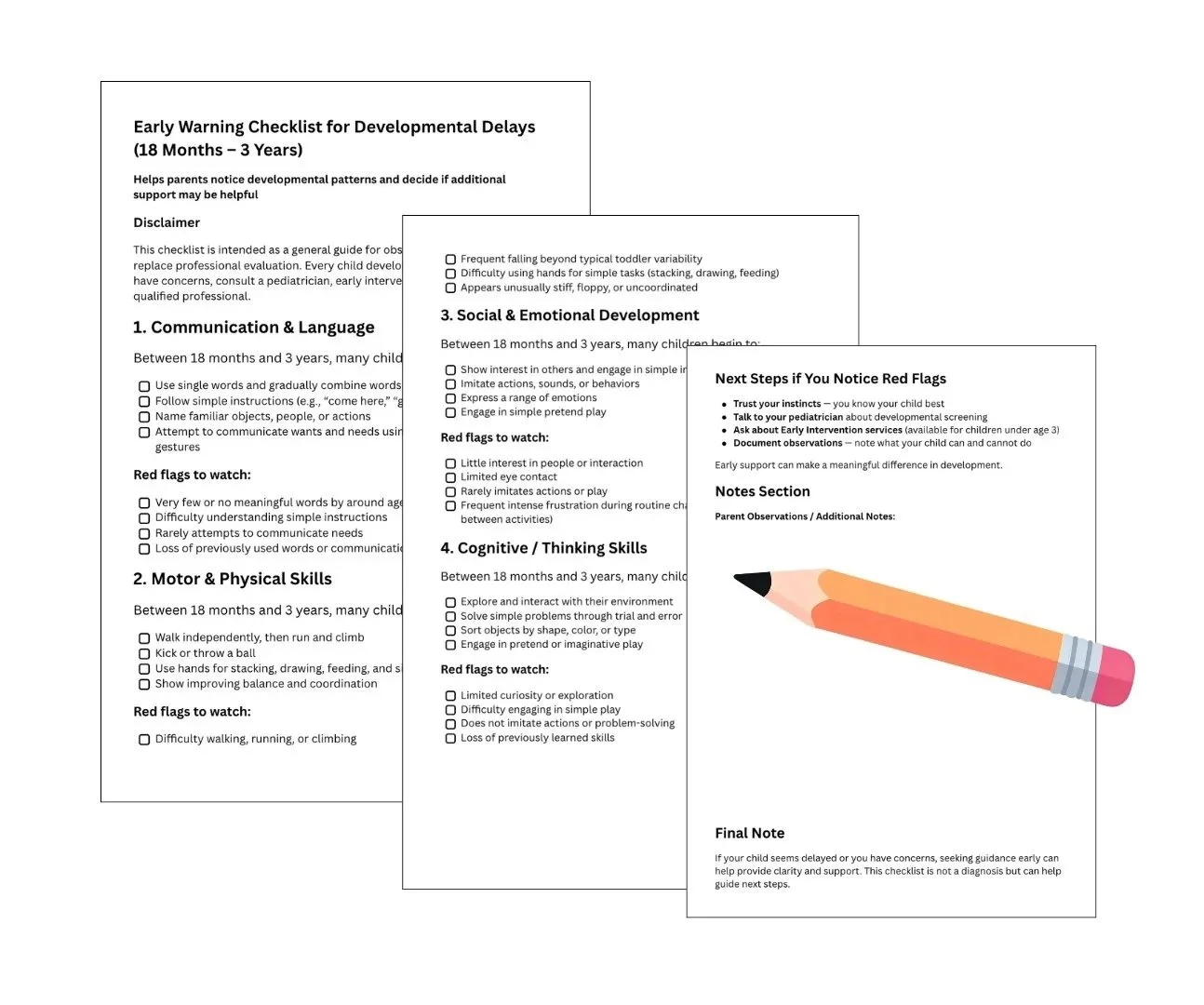
This free checklist helps you identify developmental and early learning patterns in children between 18 months and 3 years — so you know what to look for and what to do next.
⬇ Download the Free Milestone Checklist (18 Months – 3 Years)
Not sure what you're looking for? Explore more free checklists:
Learn more about Developmental Milestones ↓
Signs a Child May Need Additional Support (18 Months – 3 Years)
Communication & Language
Limited vocabulary for age
Difficulty combining words
Trouble understanding simple instructions
Cognitive & Early Learning
Limited interest in books or naming objects
Difficulty matching or sorting
Short attention span for simple tasks
Motor & Physical Skills
Delays in walking, running, or climbing
Difficulty using hands (stacking, drawing, feeding)
Avoids physical exploration
Social & Emotional
Limited interest in other children
Difficulty with routines or transitions
Frequent frustration or meltdowns
How to Support Your Child
Break learning into small, manageable steps
Use repetition and consistent routines
Model language and actions clearly
Use visuals and hands-on activities
Keep the environment calm and structured
Why Early Support Matters
Early childhood builds the foundation for:
communication
behavior
independence
With the right support, children can make strong progress at their own pace.
Download Section
⬇ Download the Developmental & Early Learning Checklist (18 Months – 3 Years)
This checklist helps you track:
communication
learning
motor skills
social development
This is not a diagnosis. For evaluation, consult a qualified professional.
Explore More Neurodivergent Checklists
Every child’s brain is unique, and neurodivergent traits can show up in many different ways. If you want to explore other areas of learning, behavior, and development, these individual checklists can help you observe specific traits and find strategies to support your child:
Neurodivergence Overview – Learn about neurodivergent traits, understand differences in thinking, learning, and behavior, and access a general neurodivergence checklist.
Autism Spectrum Disorder (ASD)- Challenges in social communication, behavior, and restricted interests, often with unique sensory and learning styles.
ADHD Checklist for Children – Signs, traits, and practical strategies for attention, focus, and impulse control.
Dyslexia Checklist for Children– Reading, decoding, and language-related traits.
Dyscalculia Checklist for Children – Number sense, math skills, and problem-solving differences.
Dysgraphia Checklist for Children – Handwriting, fine motor, and written expression challenges.
Dyspraxia Checklist for Children – Coordination, motor planning, and daily activity support.
Sensory Processing Disorder (SPD) Checklist – Sensory sensitivities, seeking or avoiding input, and self-regulation.
Executive Functioning Checklist for Children– Planning, organization, task completion, and memory support.
Each checklist links to a dedicated page with practical tips and strategies to help children thrive. Tracking behaviors over time can provide useful insights for parents and caregivers and guide discussions with professionals.
Observing Learning and Development Differences: Guidance for Parents
Seeing your child show signs that match one or more of these categories can feel overwhelming, but it does not automatically mean they have a diagnosis. Many behaviors may be part of a temporary developmental phase, while others may reflect a neurodivergent learning style. The key is to keep observing your child, track behaviors using checklists, and consult a pediatrician, psychologist, or specialist for professional guidance. While a diagnosis may initially feel overwhelming, it can be a crucial step in providing your child with the right support.
By focusing on your child’s individual strengths and needs, and using positive reinforcement and structured support, you can help them feel confident, engage fully in learning, and develop skills that will benefit them long-term. Understanding these differences early allows you to provide targeted strategies, and support your child’s growth in both academic and life skills.
Takeaway: Every child is unique, and early observation combined with practical strategies and professional guidance can make a meaningful difference in their development.