

Free ADHD Checklist for Children – Signs, Traits, and Support Strategies
Is Your Child Struggling to Focus, Sit Still, or Follow Through?
Something feels off — but it’s hard to explain.
Maybe your child:
gets distracted easily
forgets instructions quickly
struggles to sit still or finish tasks
seems capable, but things still fall apart
If that sounds familiar, you’re not alone.
This page will help you understand common signs of ADHD in children, what they can look like in everyday life, and what you can do to support your child.
Explore more checklists:
What is ADHD?
In short, ADHD (Attention-Deficit/Hyperactivity Disorder) affects how children focus, follow instructions, manage impulses, and regulate their energy.
It is one of the most common neurodevelopmental conditions in children and can impact learning, daily routines, and social interactions.
Children with ADHD may have difficulty:
staying focused
following instructions
controlling impulses
managing activity levels
ADHD can present in different ways:
Inattentive presentation
Difficulty staying focused, organizing tasks, and following throughHyperactive-impulsive presentation
High energy, impulsivity, difficulty staying still or waitingCombined presentation
A mix of both inattention and hyperactivity/impulsivity
Signs of ADHD in Children
Children with ADHD may show some of the following patterns. Not every child will show all of these.
Inattention
Difficulty staying focused on tasks
Forgetting instructions or losing track of steps
Losing items (e.g., school materials, toys)
Daydreaming or seeming not fully engaged
Hyperactivity
Constant movement or fidgeting
Difficulty staying seated when expected
Excessive talking or noise
Impulsivity
Interrupting others
Acting without thinking
Difficulty waiting their turn
Difficulty stopping once engaged in an activity
Everyday Challenges
Difficulty starting tasks or assignments
Difficulty completing tasks or assignments
Trouble following multi-step instructions
Becoming easily overwhelmed
Starting tasks but not finishing them
Not every child will show all of these signs—but patterns over time can give you important clues.
Many children are active, impulsive, or easily distracted at times. But if these behaviors are frequent, intense, or begin to affect daily life, learning, or relationships, it may be worth taking a closer look.
Co-occurring Conditions
ADHD can occur alongside other challenges such as anxiety, learning differences, or dyslexia.
If you notice patterns across multiple areas (e.g., attention, learning, behavior, or emotions), it may be helpful to seek a more comprehensive evaluation.
ADHD in Girls and Boys
ADHD can present differently in girls and boys, and some patterns may be less noticeable. These differences do not apply to every child, but they can help explain why ADHD is sometimes recognized later.
Boys are more often recognized for hyperactive and impulsive behaviors, such as constant movement, interrupting, or difficulty sitting still
Girls may show more inattentive patterns, such as daydreaming, difficulty staying organized, or appearing quiet but struggling internally
Because these patterns can be more subtle, ADHD in girls is sometimes identified later.
How to Support a Child with ADHD
Supporting a child with ADHD works best when strategies are clear, structured, and consistent.
Create Structure and Routine
Use predictable daily routines
Set clear expectations
Use visual schedules when possible
Break Tasks Into Smaller Steps
Focus on one step at a time
Avoid giving too many instructions at once
Adjust the Environment
Minimize distractions
Allow movement breaks
Use flexible seating if needed
Use Visual Support
Checklists, planners, or step-by-step guides
Keep instructions visible and simple
Reinforce Effort and Progress
Acknowledge small successes
Keep feedback consistent and calm
Structured, Hands-On Learning
Keep learning active and engaging
Connect tasks to the child’s interests
Use step-by-step approaches (like the Densing Teaching Method →)
Why Support at Home Matters
Daily routines and structure help children feel more in control
Small adjustments at home can make learning and behavior easier
Consistent support builds confidence over time
Looking for simple ways to support your child at home?
Read this guide: How Can I Support My Child at Home Without Causing Frustration?→
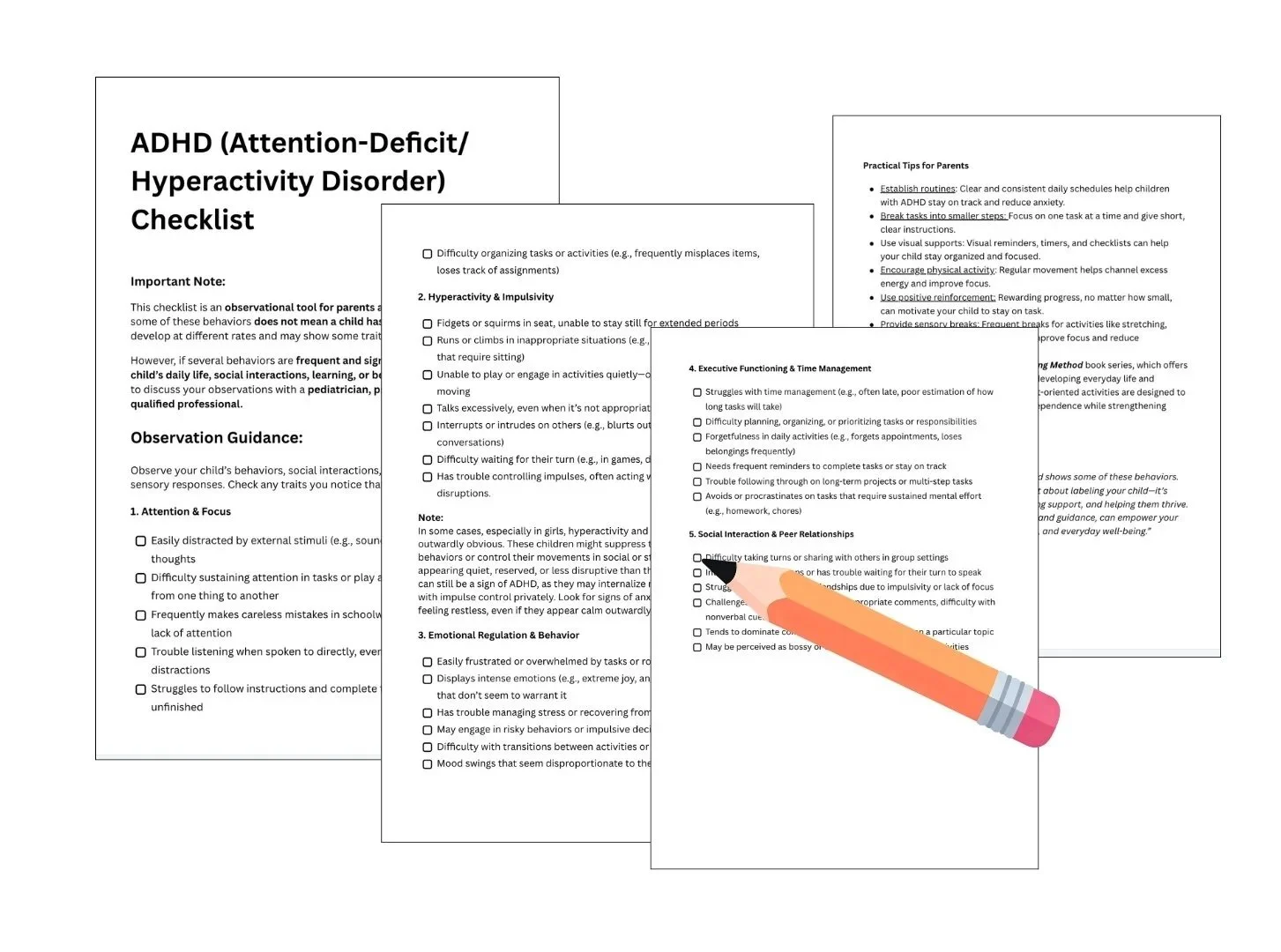
Download the ADHD Checklist
If you’re noticing some of these patterns, this checklist can help you clearly track what’s happening and better understand where your child may need support.
It can be useful for:
tracking behaviors over time
identifying patterns across situations
preparing for conversations with teachers or professionals
This checklist is not a diagnosis. For a formal evaluation, consult a qualified professional.
Explore More Neurodivergent Checklists
Every child’s brain is unique, and neurodivergent traits can show up in many different ways. If you want to explore other areas of learning, behavior, and development, these individual checklists can help you observe specific traits and find strategies to support your child:
Neurodivergence Overview – Learn about neurodivergent traits, understand differences in thinking, learning, and behavior, and access a general neurodivergence checklist.
Autism Spectrum Disorder (ASD) Checklist – Social communication, repetitive behaviors, and sensory differences.
Dyslexia Checklist for Children – Reading, decoding, and language-related traits.
Dyscalculia Checklist for Children – Number sense, math skills, and problem-solving differences.
Dysgraphia Checklist for Children – Handwriting, fine motor, and written expression challenges.
Dyspraxia Checklist for Children – Coordination, motor planning, and daily activity support.
Sensory Processing Disorder (SPD) Checklist – Sensory sensitivities, seeking or avoiding input, and self-regulation.
Executive Functioning Checklist for Children – Planning, organization, task completion, and memory support.
Each checklist links to a dedicated page with practical tips and strategies to help children thrive. Tracking behaviors over time can provide useful insights for parents and caregivers and guide discussions with professionals.
Observing Learning and Development Differences: Guidance for Parents
Seeing your child show signs that match one or more of these categories can feel overwhelming, but it does not automatically mean they have a diagnosis. Many behaviors may be part of a temporary developmental phase, while others may reflect a neurodivergent learning style. The key is to keep observing your child, track behaviors using checklists, and consult a pediatrician, psychologist, or specialist for professional guidance. While a diagnosis may initially feel overwhelming, it can be a crucial step in providing your child with the right support.
By focusing on your child’s individual strengths and needs, and using positive reinforcement and structured support, you can help them feel confident, engage fully in learning, and develop skills that will benefit them long-term. Understanding these differences early allows you to provide targeted strategies, and support your child’s growth in both academic and life skills.
Takeaway: Every child is unique, and early observation combined with practical strategies and professional guidance can make a meaningful difference in their development.