

Neurodivergent Children: Signs, Checklists, and Support for Parents
Is Your Child Showing Signs of Learning Differences Like ADHD, Autism, or Other Neurodivergent Traits? You’re Not Alone—Here’s What You Need to Know.
How to identify learning differences, understand neurodivergent traits, and find simple strategies and checklists to support your child.

It’s completely natural to feel unsure or overwhelmed when your child struggles with focus, learning, or behavior. Seeking support isn’t about labeling your child—it’s about understanding how they learn and helping them build confidence and independence.
To better understand what your child is experiencing, it helps to imagine what the world might feel like from their perspective.
Explore Individual Checklists
If you want to learn more about the signs of neurodivergence in children, explore the individual checklists below covering common learning and developmental differences. Each checklist helps parents and caregivers observe patterns, organize their observations, and better understand where a child may need additional support.
Checklist Links
Each link leads to a dedicated page with detailed checklists and practical tips for parents, caregivers, and educators.
ADHD Checklist for Children – Observe behaviors related to attention, focus, hyperactivity, and impulsivity, and access practical strategies to support your child’s daily routines and learning.
Autism Spectrum Disorder (ASD) Checklist – Track social communication, sensory responses, repetitive behaviors, and unique learning traits to better understand your child’s needs.
Dyslexia Checklist for Children – Identify reading and decoding challenges, word recognition difficulties, and strategies to support reading fluency and language development.
Dyscalculia Checklist for Children– Observe challenges with numbers, math operations, and number sense, and find ways to make math learning practical and engaging.
Dysgraphia Checklist for Children – Track handwriting, fine motor coordination, and written expression challenges while learning ways to strengthen these skills.
Dyspraxia Checklist for Children – Observe difficulties with motor planning, coordination, balance, and everyday tasks, and discover hands-on strategies to improve movement skills.
Sensory Processing Disorder Checklist – Identify sensitivities or under-responsiveness to sensory input, and learn practical ways to support comfort, focus, and daily functioning.
Executive Functioning Checklist for Children– Track organization, planning, memory, and task management skills, and discover strategies to help children succeed in daily life.
Step-by-Step Guide to Understanding Neurodivergence and Supporting Your Child
Step-by-Step Guide to Understanding Neurodivergence and Supporting Your Child
What is Neurodivergence?
In short, neurodivergence refers to differences in the brain that lead to unique ways of thinking, learning, and behaving. It’s important to understand that neurodivergence is not inherently a disorder or disability. Instead, it’s a natural variation in how different brains process information. People are often categorized into two groups:
Neurotypical: People whose brains process things in ways that are considered typical.
Neurodivergent: People whose brains process information in a unique, non-typical way.
It’s essential to remember that everyone is unique. There are no two brains alike, even within these groups.
Neurodivergence: Disorder, Disability, or Condition?
Disorder: A medical diagnosis that may affect behavior, attention, or communication (e.g., ADHD, autism).
Disability: When those differences create challenges in daily life, such as learning or social interaction.
Condition: A broader term describing how someone’s development or brain function differs.
In short, neurodivergence is an umbrella term that includes both disorders and conditions. Some neurodivergent individuals may experience disabilities, while others may not. The key takeaway is that these terms describe differences, not deficiencies.
What Is Commonly Associated With Neurodivergence?
Neurodivergence encompasses a range of conditions that affect how the brain processes information. These include, but are not limited to:
ADHD (Attention-Deficit/Hyperactivity Disorder): Difficulty with attention, focus, impulse control, and hyperactivity, which can affect daily functioning and learning.
Autism Spectrum Disorder (ASD): Challenges in social communication, behavior, and restricted interests, often with unique sensory and learning styles.
Dyspraxia: Difficulty with planning and coordinating physical movements, including tasks like writing, dressing, or using utensils. It affects motor skills, balance, and coordination, making everyday activities challenging.
Dyslexia: A learning difference that affects a child's ability to read, decode words, and recognize letters or sounds. Children with dyslexia may struggle with reading fluency, spelling, and word recall, often requiring specialized strategies to succeed in reading and language tasks.
Dyscalculia: Difficulty understanding and working with math concepts, including number sense, counting, and basic operations.
Dysgraphia: Difficulty with handwriting, organizing thoughts on paper, and coordinating fine motor movements. This can lead to challenges with legible writing, spelling, and written expression.
Sensory Processing Disorder (SPD): Trouble processing and responding to sensory input, like sounds, textures, lights, or movement, leading to sensory overload or under-responsiveness.
Executive Functioning Issues: Struggles with organizing, planning, prioritizing, and managing tasks, making it difficult to stay on top of daily responsibilities.
These conditions reflect different ways of thinking and processing the world, and each one can present its own unique strengths and challenges.
How Can You Support Neurodivergent Children?
Understanding how your child learns is the first step toward helping them succeed. With the right structure, clear guidance, and supportive strategies, children can build confidence, independence, and essential skills.
Resources like the Densing Teaching Method book series→ offer step-by-step, hands-on activities to support communication, social skills, motor development, and learning while building confidence and independence.
Download Your Free Checklist
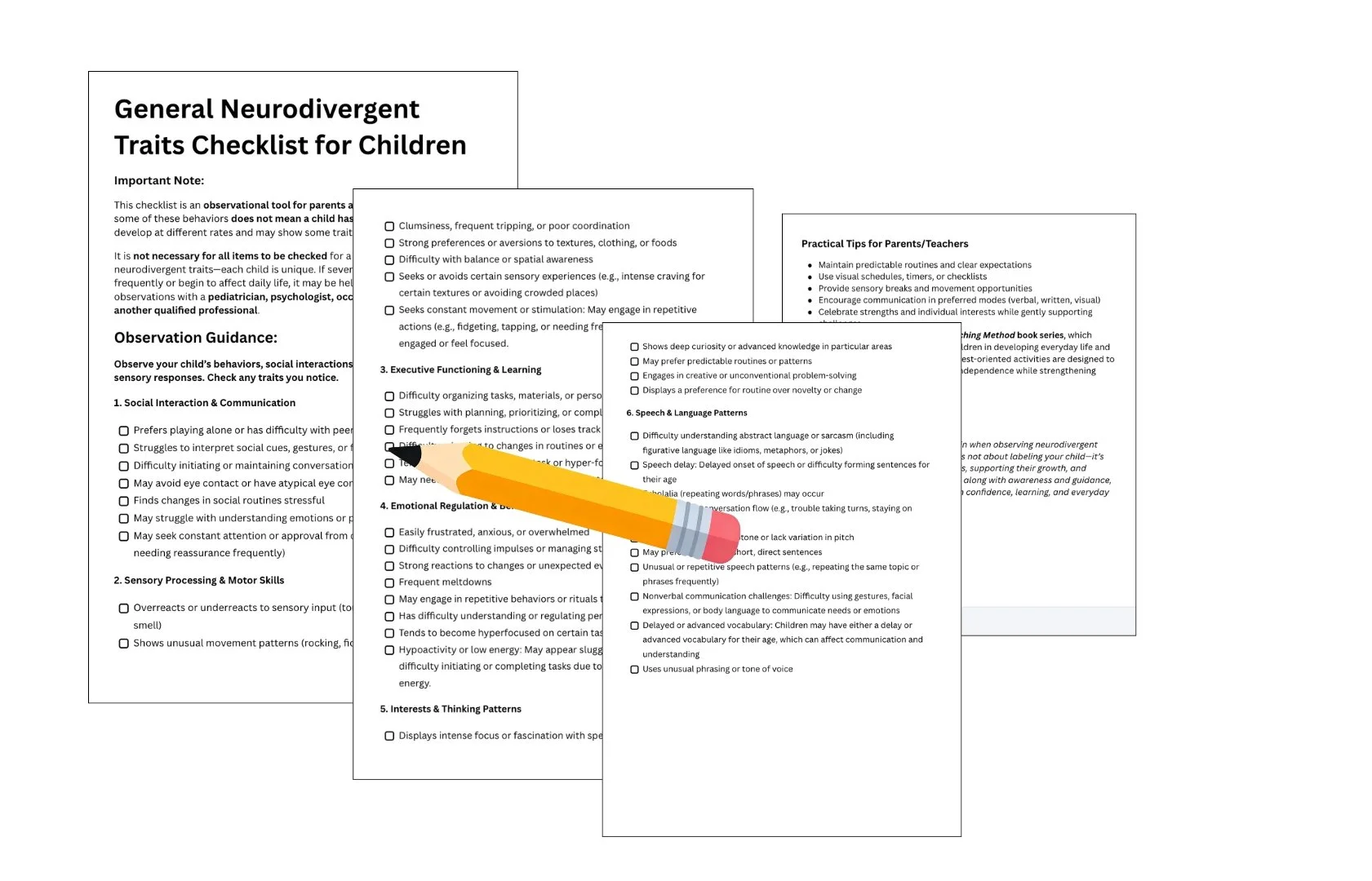
If you’re wondering whether your child may show signs of neurodivergence, this checklist can help you observe patterns in attention, learning, sensory processing, and behavior.
Note: This is not a diagnosis. For evaluation, consult a qualified professional.
[Download the Neurodivergence Traits Checklist for children here→]
Development & Milestones: Early Signs to Watch For
Children develop at different rates, but when milestones feel out of reach, it can be a sign that your child may need additional support. Differences in communication, movement, behavior, or learning often show up early—and recognizing them can help you take the next step with confidence.
Looking at how your child is developing across areas like speech, attention, motor skills, and learning can give you a clearer picture of their needs. Early support, even in small ways, can make a meaningful difference over time.
👉 See early signs of developmental delays (12–18 months) →
👉 Check signs of developmental delays (18months - 3 years) →
Seeing the World Through Your Child’s Eyes
Imagine being in a place where you don’t understand the language. People are talking all around you, but the words don’t make sense. You want to participate, but you don’t know how. It can feel confusing, isolating, and overwhelming.
Now imagine someone slowing things down—using gestures, pictures, or simple signs to help you understand. Suddenly, things feel clearer. The frustration fades, and you begin to feel included.
For many neurodivergent children, everyday learning can feel this way. With the right structure and support, things begin to make sense—and connection becomes possible.
Observing Learning and Development Differences: Guidance for Parents
Seeing your child show signs that match one or more of these categories can feel overwhelming, but it does not automatically mean they have a diagnosis. Many behaviors may be part of a temporary developmental phase, while others may reflect a neurodivergent learning style. The key is to keep observing your child, track behaviors using checklists, and consult a pediatrician, psychologist, or specialist for professional guidance. While a diagnosis may initially feel overwhelming, it can be a crucial step in providing your child with the right support.
By focusing on your child’s individual strengths and needs, and using positive reinforcement and structured support, you can help them feel confident, engage fully in learning, and develop skills that will benefit them long-term. Understanding these differences early allows you to provide targeted strategies, and support your child’s growth in both academic and life skills.
Takeaway: Every child is unique, and early observation combined with practical strategies and professional guidance can make a meaningful difference in their development.