

Free Autism Checklist for Children – Identify Early Signs and Patterns
Does This Sound Like Your Child?
They don’t respond to their name consistently.
They avoid eye contact or seem hard to engage.
They repeat the same actions over and over.
Small changes lead to strong reactions.
They focus intensely on certain objects or routines.
And something just feels different—but you can’t quite explain it.
You’re not imagining it. And it’s not about parenting.
These can be early patterns seen in children on the autism spectrum—and recognizing them early can make a real difference.
Explore more checklists:
What is Autism?
In short, Autism Spectrum Disorder (ASD) affects how a child communicates, interacts, and processes the world around them.
Because it is a spectrum, children can show a wide range of differences in how they experience and respond to everyday situations. Some children may have milder challenges, while others may need more significant support.
Some children may:
have difficulty with social interaction or back-and-forth communication
struggle with flexible thinking or changes in routine
experience sensory sensitivities (sounds, textures, movement)
rely on repetition or routines to feel secure
Others may need more structured support with:
communication and language
daily routines and transitions
emotional regulation
learning and independence
Children can show different patterns of strengths and challenges, which is why support needs to be individualized.
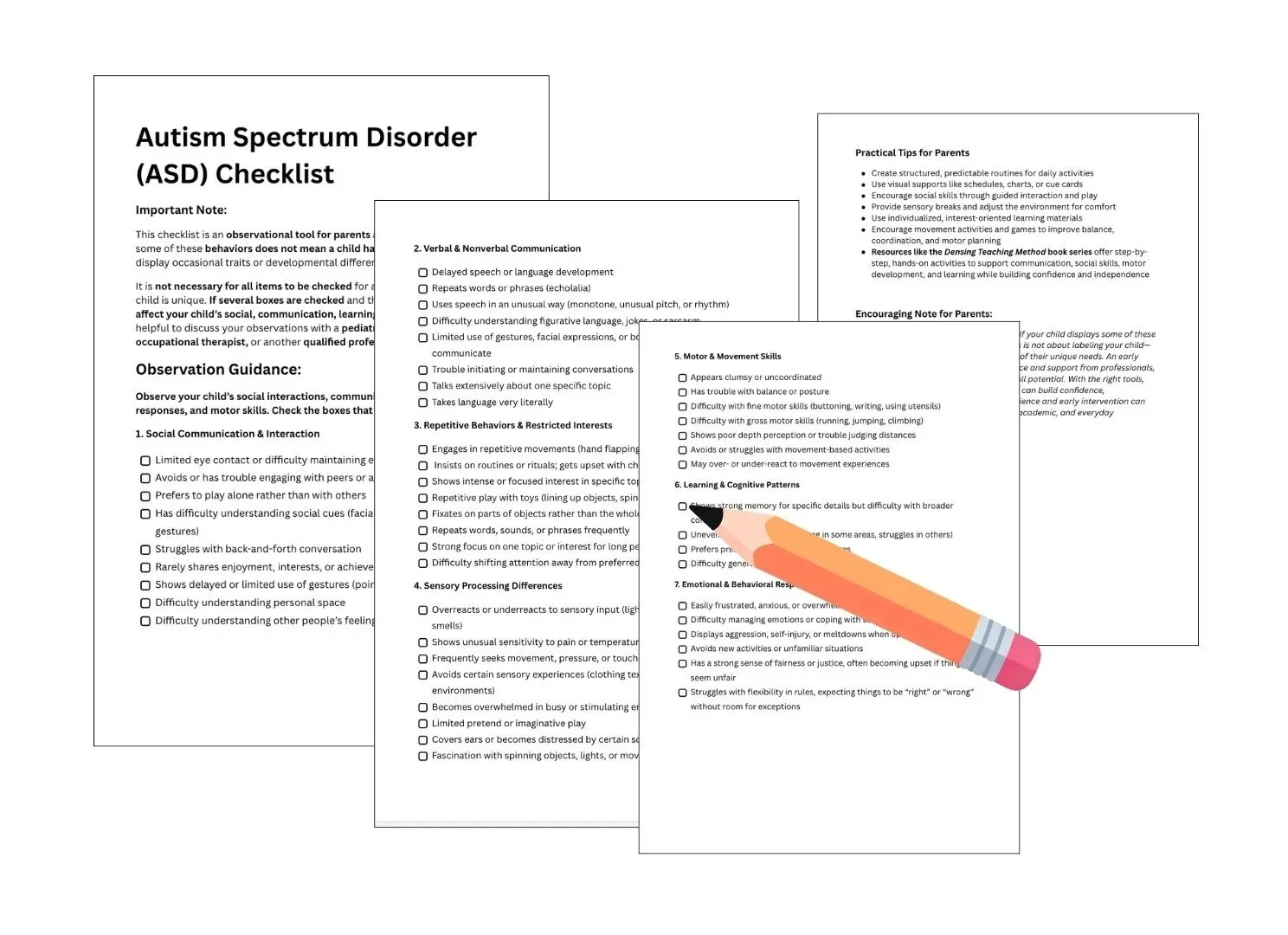
Signs of Autism in Children
Children with autism may show some of the following patterns. Not every child will show all of these.
Social Communication
Limited eye contact
Difficulty understanding social cues
Less interest in playing with peers
Difficulty with back-and-forth interaction
Speech and Language
Delayed speech or limited vocabulary
Difficulty understanding language
Using words in unusual ways or repeating phrases
Behavior and Routines
Repetitive movements (e.g., hand-flapping, rocking, spinning objects)
Repeating actions with objects (e.g., lining up toys, spinning wheels)
Strong preference for routines
Distress when routines change
Interests
Very focused interest in specific topics or objects
Repeating the same activities over and over
Sensory Processing
Strong reactions to sounds, lights, textures, or smells
Either over-sensitive or under-responsive to sensory input
Motor Skills
Delays in motor development (e.g., crawling, walking later than expected)
Difficulty with coordination (running, jumping, climbing)
Difficulty with fine motor tasks (e.g., using utensils, buttoning, drawing)
Flexibility and Change
Difficulty adjusting to new situations
Resistance to transitions
Understanding Others
Difficulty reading facial expressions or tone of voice
Challenges understanding body language
Not every child will show all of these signs—but patterns over time can give you important clues.
Children develop differently, especially in communication, behavior, and social interaction. But if differences in communication, routines, or responses to the environment are consistent and impact daily life, it may be worth taking a closer look.
How to Support a Child with Autism
Supporting a child with autism works best when strategies are clear, consistent, and adapted to how the child learns.
Structure and Routine
Keep daily routines predictable
Use visual schedules where possible
Clear Communication
Use simple, direct language
Support instructions with visuals (pictures, steps, schedules)
Sensory Support
Allow movement breaks
Provide quiet spaces when needed
Positive Reinforcement
Acknowledge small steps
Keep feedback consistent and calm
Motor Skill Development
Use hands-on activities (puzzles, stacking, drawing)
Build both fine and gross motor skills
Structured, Hands-On Learning
Keep learning visual and interactive
Connect activities to the child’s interests
Use step-by-step approaches (like the Densing Teaching Method →)
Why Early Support Matters
Early support helps build communication and independence
It makes learning and daily routines more manageable
It allows challenges to be addressed before they grow
Early intervention services can provide structured support, guidance, and practical strategies for both children and parents.
Not sure how early intervention works or where to start?
Download the Autism Checklist
Track patterns over time
Prepare for conversations with professionals
Identify areas where support may help
This checklist is not a diagnosis. For evaluation, consult a qualified professional.
Explore More Neurodivergent Checklists
Every child’s brain is unique, and neurodivergent traits can show up in many different ways. If you want to explore other areas of learning, behavior, and development, these individual checklists can help you observe specific traits and find strategies to support your child:
Neurodivergence Overview – Learn about neurodivergent traits, understand differences in thinking, learning, and behavior, and access a general neurodivergence checklist.
ADHD Checklist for Children – Signs, traits, and practical strategies for attention, focus, and impulse control.
Dyslexia Checklist for Children – Reading, decoding, and language-related traits.
Dyscalculia Checklist for Children – Number sense, math skills, and problem-solving differences.
Dysgraphia Checklist for Children – Handwriting, fine motor, and written expression challenges.
Dyspraxia Checklist for Children – Coordination, motor planning, and daily activity support.
Sensory Processing Disorder (SPD) Checklist – Sensory sensitivities, seeking or avoiding input, and self-regulation.
Executive Functioning Checklist for Children – Planning, organization, task completion, and memory support.
Each checklist links to a dedicated page with practical tips and strategies to help children thrive. Tracking behaviors over time can provide useful insights for parents and caregivers and guide discussions with professionals.
Observing Learning and Development Differences: Guidance for Parents
Seeing your child show signs that match one or more of these categories can feel overwhelming, but it does not automatically mean they have a diagnosis. Many behaviors may be part of a temporary developmental phase, while others may reflect a neurodivergent learning style. The key is to keep observing your child, track behaviors using checklists, and consult a pediatrician, psychologist, or specialist for professional guidance. While a diagnosis may initially feel overwhelming, it can be a crucial step in providing your child with the right support.
By focusing on your child’s individual strengths and needs, and using positive reinforcement and structured support, you can help them feel confident, engage fully in learning, and develop skills that will benefit them long-term. Understanding these differences early allows you to provide targeted strategies, and support your child’s growth in both academic and life skills.
Takeaway: Every child is unique, and early observation combined with practical strategies and professional guidance can make a meaningful difference in their development.