


Teaching a Child with Down Syndrome: Learning Strategies and Support
Practical Support for Reading, Speech, Fine Motor Skills, Executive Functioning and Sensory Processing
Every child with Down syndrome learns differently. Some children may need extra support with speech, reading, fine motor skills, sensory processing, memory, or completing multi step tasks. Others may show strengths in some or all of these areas.
Understanding how your child learns can make it easier to choose activities, teaching strategies, and support that fit their individual needs.
Executive Functioning
Learn about working memory, organization, following steps, and task completion.
Speech Delay
Learn about speech and language development, communication, and when extra support may help.
Reading Difficulties
Is your child struggling to learn to read? See practical ideas using visual, hands-on practice.
Sensory Processing
Learn about sensory seeking, overwhelm, movement needs, and sensory differences.
Fine Motor Skills
Learn about handwriting, coordination, and hands-on activities to build fine motor control.
On this page, you can learn more about:
Understanding Down Syndrome and Learning
Down syndrome is a genetic condition caused by an extra copy of chromosome 21. It can affect physical development, learning, speech and language, and the rate at which a child develops different skills.
Children with Down syndrome do not all have the same abilities or learning difficulties. Each child has their own combination of strengths and areas where they may need extra support.
However, research has found patterns in how many children with Down syndrome learn. The National Down Syndrome Society describes a developmental learning profile that can include individual strengths as well as challenges involving sensory, physical, cognitive, language, and learning skills.
A child may understand more than they can easily express. They may learn well when information is shown visually or demonstrated instead of only explained verbally. Repetition, practice, and breaking a larger task into smaller steps can also make learning easier.
This means that difficulty completing a task does not necessarily mean a child does not understand it. Sometimes the way the information is presented needs to change.
Down Syndrome and Executive Functioning
Executive functioning is the group of skills we use to organize ourselves, remember information, control our attention, start a task, change strategies, and work toward a goal.
Research has found that executive functioning can be an area of difficulty for many children with Down syndrome. Working memory can be particularly challenging, although every child has their own pattern of strengths and difficulties.
A child with executive functioning difficulties might:
Forget part of an instruction
Have trouble following several steps in the correct order
Need reminders to begin a task
Have difficulty switching from one activity to another
Lose track of what they were doing
Need help organizing materials
Have trouble planning how to complete a new activity
Following several instructions at once can place a high demand on working memory. For example, a child may find it difficult to remember and complete a sequence such as getting their shoes, packing their homework, and bringing their jacket.
Breaking the task into smaller steps or providing visual instructions can make the sequence easier to follow and reduce the amount of information the child needs to remember at one time.
Visual schedules, routines, checklists, demonstrations, and step-by-step instructions can reduce the amount of information the child has to hold in memory at once.
Does your child struggle with remembering instructions, organizing tasks, staying focused, or completing several steps?
Explore these resources:
Free Executive Functioning Checklist →
Learn about signs of difficulty with working memory, planning, organization, flexible thinking, and task completion.
Why Can't My Child Focus? →
Learn about possible reasons a child may struggle with attention and practical ways to support focus and learning.
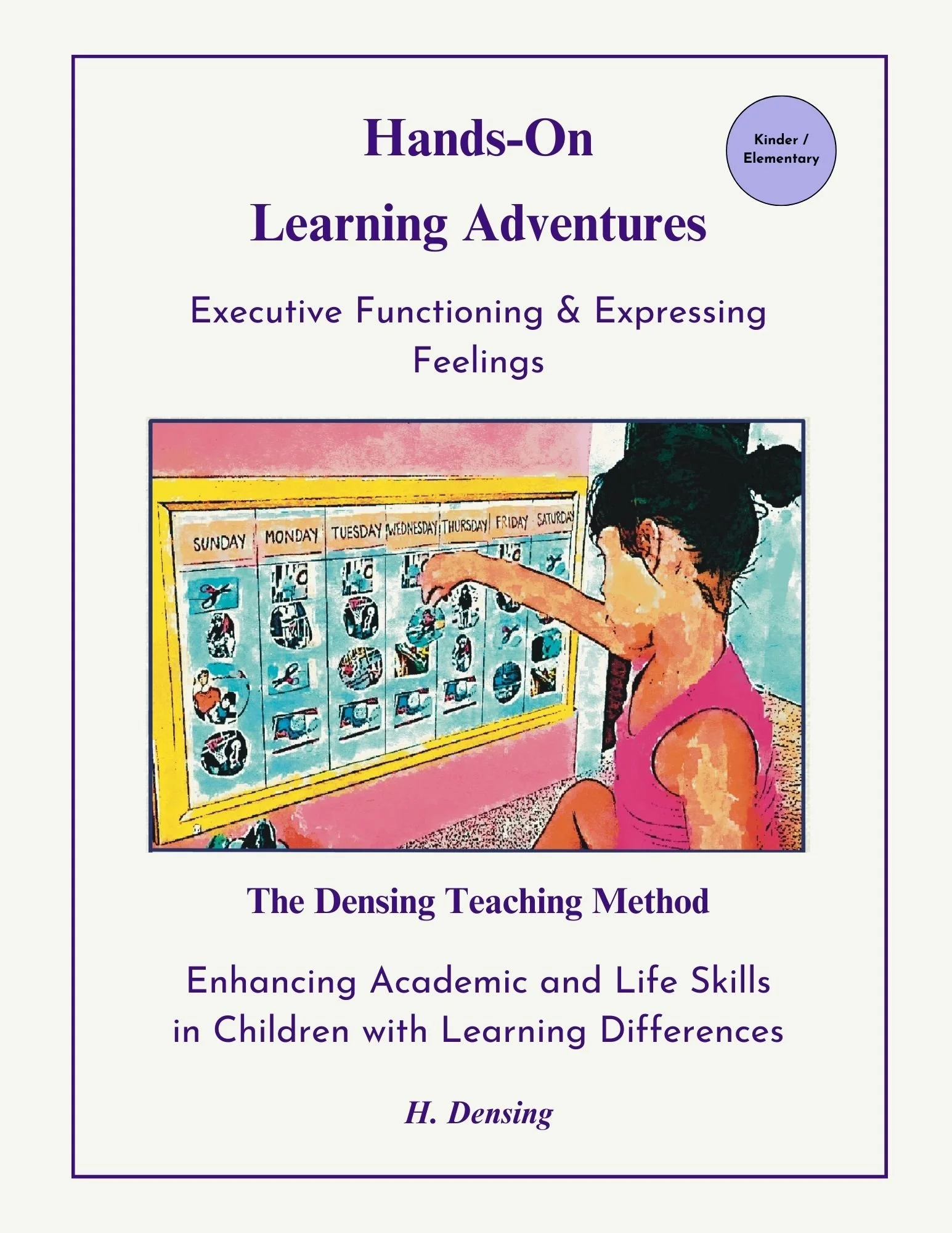
The Densing Teaching Method: Executive Functioning & Expressing Feelings book includes more than 60 hands-on activities designed to support executive functioning and emotional development. Activities focus on skills such as self-control, attention, flexible thinking, organization, time management, and emotional regulation.
The activities are designed to be interactive and adaptable, so parents and teachers can connect learning with a child's individual needs and interests while practicing important everyday skills.
Explore the Executive Functioning and Expressing Feelings book →
Down Syndrome and Sensory Processing
Sensory processing is the way the brain receives and responds to information from the senses.
This includes much more than sight, sound, taste, touch, and smell. The sensory system also provides information about movement, balance, and where the body is in space.
Some children with Down syndrome experience differences in sensory processing. Research involving children with Down syndrome has found sensory differences including sensory seeking, underresponsiveness, and difficulty filtering auditory information. However, sensory needs vary considerably between children.
A child might:
Become overwhelmed by loud or busy environments
Seem not to notice certain sounds or sensations
Constantly seek movement
Enjoy jumping, spinning, pushing, or climbing
Dislike particular textures
Have difficulty concentrating when there is a lot happening around them
Seek strong pressure or physical input
Sensory responses can also affect learning. A child who is overwhelmed by classroom noise may have much more difficulty listening to instructions. A child who needs movement may find sitting still for a long lesson extremely difficult.
Instead of looking only at the behavior, it can help to ask what sensory information the child may be responding to or seeking.
Does your child seem easily overwhelmed by sensory input or constantly seek movement and stimulation?
Learn more about sensory processing in children and use our free Sensory Processing Checklist →
Down Syndrome and Reading Difficulties
Children with Down syndrome can learn to read, but the different skills involved in reading may not develop at the same rate.
Reading is not one single skill. A child needs to recognize letters, connect letters with sounds, understand spoken language, remember sound patterns, blend sounds together, recognize words, and understand what they read.
Research has found that some children with Down syndrome may have particular difficulty with phonological awareness and decoding. These are the skills used to recognize and work with the sounds in words and connect those sounds with written letters.
Some children with Down syndrome become very good at recognizing familiar written words, even when phonological awareness and decoding remain difficult.
For these children, learning whole words by sight can be a useful and successful way to build reading skills. Repeated exposure to meaningful words can help a child develop a larger sight vocabulary and begin reading familiar sentences with greater confidence.
Phonics and phonological awareness can also be introduced when they are helpful and appropriate for the individual child. Research suggests that these approaches can support reading development for some children with Down syndrome, but children do not all learn to read in the same way.
A flexible approach can include:
• Learning meaningful whole words by sight
• Matching written words with pictures
• Repeated practice with familiar words
• Reading short, predictable sentences
• Introducing letter sounds and phonics at a pace that fits the child
• Using the child's interests to choose motivating words and reading material
The goal is to build on the way the individual child learns best rather than relying on only one method.
A child's language development can also affect reading. If understanding or producing spoken language is difficult, learning the meaning of written sentences may require additional support.
Is your child having much more difficulty learning to read than you expected?
Reading Difficulties →
Learn about common reasons a child may struggle to learn to read and practical ways to support reading development.
Free Dyslexia Checklist →
Learn about signs that may suggest dyslexia or another specific reading difficulty.
A reading difficulty in a child with Down syndrome does not automatically mean that the child has dyslexia. Reading skills should be considered as part of the child's overall developmental and learning profile.
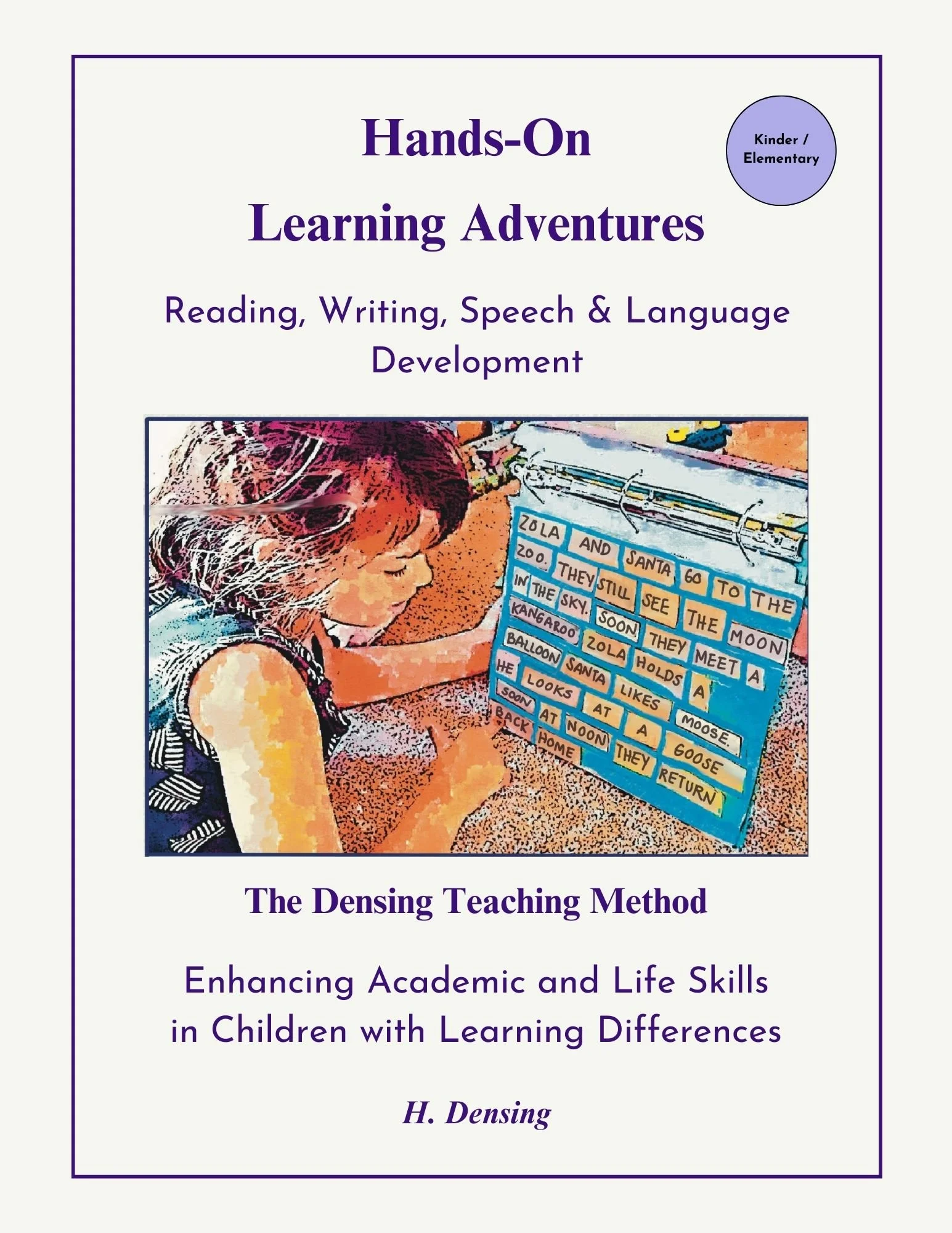
If your child benefits from visual, hands-on, and interest-based learning, the Densing Teaching Method: Reading, Writing, Speech and Language Development book includes practical games and activities that can be adapted to the child's own interests. These activities are designed to make reading and language practice more playful, meaningful, and engaging.
Explore the Reading, Writing, Speech and Language Development book →
Down Syndrome and Fine Motor Skills
Fine motor skills involve controlled movements of the hands and fingers.
Children use these skills throughout the day for activities such as:
• Holding a pencil
• Drawing
• Writing
• Cutting with scissors
• Using utensils
• Turning pages
• Opening containers
• Fastening buttons
• Pulling up zippers
• Building with small objects
Motor development can be delayed in children with Down syndrome, and research has found that fine motor and coordination tasks can be particularly challenging for some children.
Fine motor difficulties can become especially noticeable when a child begins school.
A child may understand the answer to a worksheet but struggle to write it. They may know what they want to draw but have difficulty controlling the pencil. Cutting, coloring, or handwriting may take much longer than expected.
It is important not to confuse the physical difficulty of completing the task with the child's understanding of the task.
Fine motor skills can be practiced through everyday activities.
For example:
• Building with blocks
• Using modeling dough
• Picking up small objects
• Stringing beads
• Drawing and coloring
• Using tongs
• Opening and closing containers
• Practicing buttons and zippers
• Cutting simple shapes
Activities can start with easier movements and gradually become more difficult as the child's control improves.
Does your child struggle with handwriting, scissors, buttons, drawing, or other hand movements?
Explore these resources:
Fine Motor Development →
Learn about common fine motor challenges and activities that can help build hand strength, coordination, and control.
Free Dyspraxia Checklist →
Learn about signs of motor planning and coordination difficulties that may affect everyday tasks.
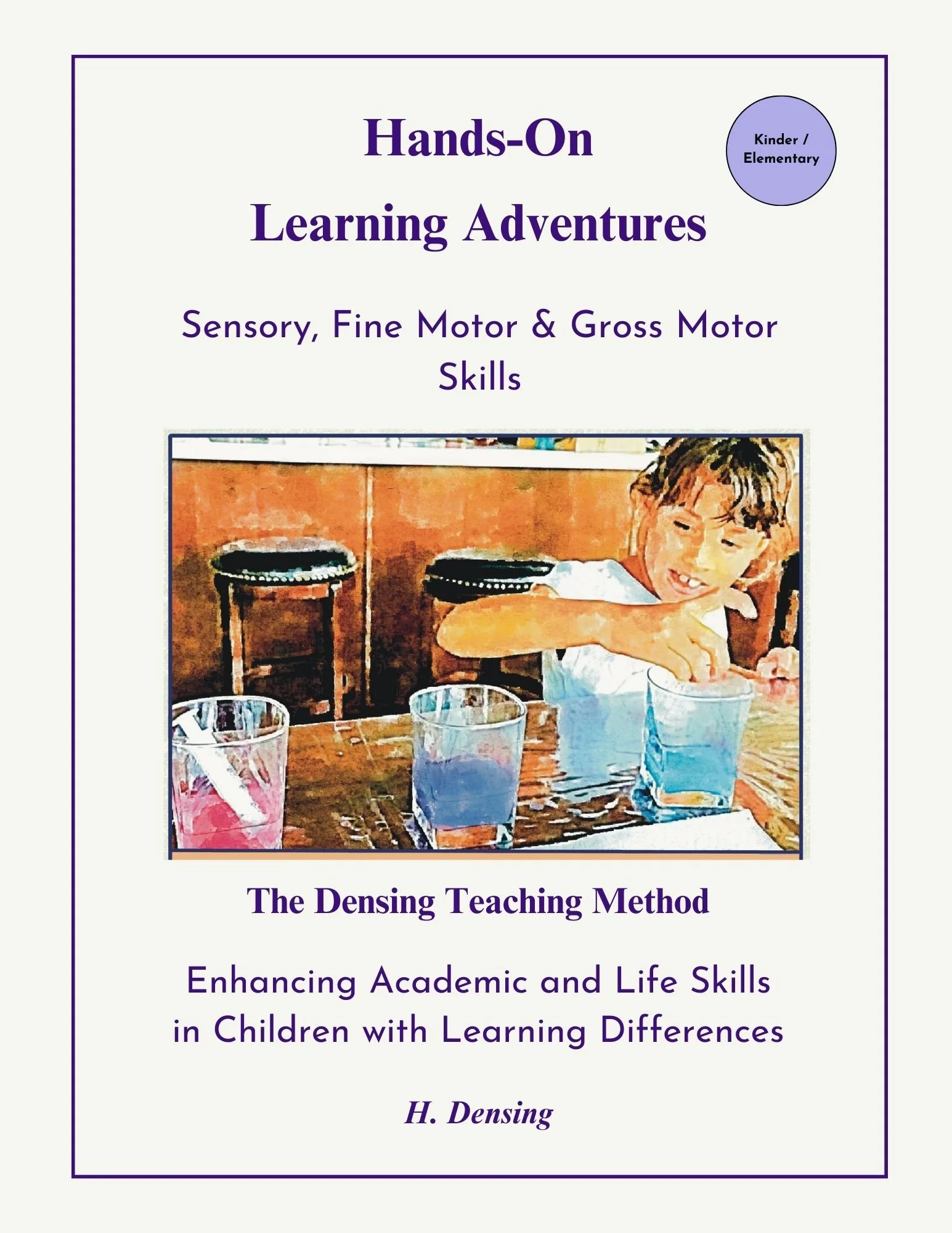
The Densing Teaching Method: Sensory, Fine and Gross Motor Skills book includes 100+ hands-on activities that can be adapted to a child's individual interests. Using favorite themes, objects, or activities can make challenging motor skills feel more playful and motivating while still giving the child repeated practice.
Down Syndrome and Speech and Language Development
Speech and language development is another important area for many children with Down syndrome.
Speech and language are related, but they are not exactly the same thing.
Language is understanding and using words, sentences, and ideas.
Speech is physically producing sounds clearly enough for another person to understand.
A child can understand a great deal but still have difficulty expressing those thoughts clearly.
The National Down Syndrome Society notes that receptive language, meaning what a child understands, may be stronger than expressive language for some children with Down syndrome. Research has also documented difficulties involving speech production and speech intelligibility.
This difference is important.
If a child cannot easily say what they know, adults may accidentally underestimate what the child understands.
Children may benefit from communication support that includes:
Speaking clearly
Giving the child time to respond
Using pictures with spoken words
Demonstrating what words mean
Reading together
Repeating new vocabulary in different situations
Encouraging communication without constantly correcting speech
Using gestures, pictures, signs, or other communication supports when helpful
Some children may benefit from augmentative and alternative communication (AAC) when speech alone does not allow them to communicate easily. AAC can include gestures, signs, pictures, communication boards, speech generating devices, or communication apps.
Using AAC does not mean giving up on spoken language. The American Speech Language Hearing Association notes that AAC can support communication and language development and does not prevent children from developing speech.
Research specific to young children with Down syndrome has also found that AAC based language intervention can support expressive language development, including the use of grammar.
If your child has difficulty expressing their needs, thoughts, or ideas, a speech language pathologist can help determine whether AAC or another form of communication support may be useful.
Is your child speaking much less than expected, difficult to understand, or struggling to communicate what they know?
Explore these resources:
Speech Development Checklist →
Learn about common signs of speech and language delay and when additional support may be helpful.
Childhood Apraxia of Speech →
Learn about signs that may suggest difficulty planning and coordinating the movements needed for speech.
Teaching Strategies That May Help a Child With Down Syndrome
There is no single teaching method that will work for every child with Down syndrome.
The goal is to find out how the individual child learns best.
Some children benefit from combining spoken instruction with visual and hands on learning.
Show instead of only telling
If you want a child to complete a task, demonstrate it.
Instead of only saying, “Put the red block underneath the blue block,” show the child what underneath means while saying the word.
This connects spoken language with something the child can see.
Break activities into small steps
A task that looks simple to an adult may actually contain many smaller skills.
“Get dressed” might involve finding clothes, identifying which item goes on first, orienting the clothing correctly, balancing while dressing, using fine motor skills, and remembering what comes next.
Teaching those steps individually can make the whole activity more manageable.
Use visual instructions
Pictures can remain visible after spoken words are gone.
A picture schedule can show:
Get toothbrush
Put toothpaste on toothbrush
Brush teeth
Rinse
Put toothbrush away
The child does not have to remember the entire sequence at once.
Give enough processing time
After asking a question or giving an instruction, give the child time to process what was said and decide how to respond.
Repeating the question immediately or adding more instructions can sometimes make processing harder.
Practice skills in everyday situations
Skills become more useful when children practice them in different places and activities.
Counting can happen while putting plates on the table.
Fine motor skills can be practiced through playful activities such as tracing shapes in sand, making lines or patterns with small rocks, placing large objects into a container, peeling stickers, turning pages, moving soft pieces from one bowl to another, or creating pictures with natural materials.
Whenever possible, use topics and activities your child already enjoys. A favorite animal, vehicle, color, character, or hobby can be turned into a playful way to practice skills that might otherwise feel difficult or frustrating.
Reading can happen while following a recipe, choosing a snack, or reading signs.
Sequencing can be practiced while making a sandwich.
Learning does not have to happen only at a desk.
Build on strengths
A child who responds well to pictures can use visual supports while learning reading, math, routines, and daily living skills.
A child who enjoys movement can practice concepts through physical activities.
A child who loves music can practice words, sounds, numbers, or sequences through songs.
A child's own interests can also make learning more meaningful. Favorite animals, characters, activities, or topics can be included in lessons to make practice feel more playful and motivating.
Hands On and Visual Learning with the Densing Teaching Method
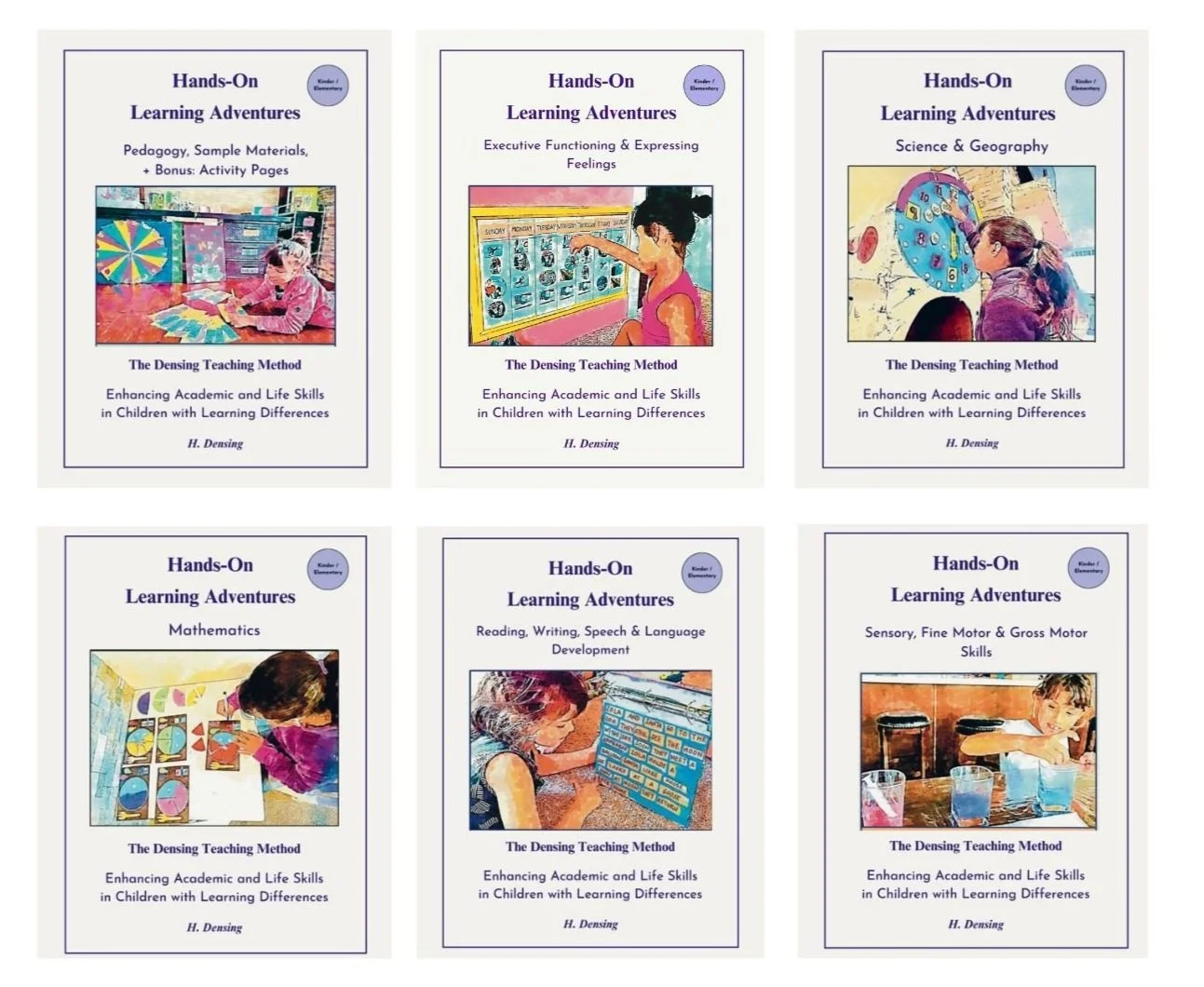
The Densing Teaching Method book series was created around many of these same ideas. Activities use visual examples, hands on learning, repetition, and small step by step tasks. A child's individual interests can also be included to make learning more playful and engaging.
The books include activities that support areas such as reading, writing, math, communication, fine motor skills, gross motor skills, sensory learning, and everyday skills.
Supporting the Whole Child
A child with Down syndrome may need support in several areas at the same time.
Speech can affect reading.
Executive functioning can affect the ability to complete daily tasks or schoolwork.
Fine motor difficulties can make writing harder.
Sensory overload can affect attention.
These areas are connected, which is why looking at the whole child is important.
At the same time, having Down syndrome does not mean that a child will struggle in every area discussed on this page.
Use the sections that are relevant to your child.
Sources and Further Information
Research published through the National Library of Medicine and PubMed
Important: This information is intended for educational purposes. Children with Down syndrome have individual developmental, medical, and educational needs. Concerns about your child's development, speech, hearing, motor skills, learning, or behavior should be discussed with an appropriate qualified professional.