

Homeschooling a Neurodivergent Child: 5 Mindset Shifts to Make Learning Easier
If you are homeschooling a neurodivergent child, it can be easy to spend so much time thinking about what is not working that you stop noticing what is.
The reading lesson that ended in frustration.
The math problem your child refused to finish.
The schedule that completely fell apart.
The child who could not sit still long enough to get through the lesson you carefully planned.
I have been there.
And one of the biggest changes in our homeschool did not come from finding the perfect curriculum or creating a better schedule.
It came from changing the way I looked at learning.
Over time, I began to realize that homeschooling a neurodivergent child often requires us to become more flexible, more curious, and more willing to let go of what we think learning is supposed to look like.
These five mindset shifts changed the way I homeschool.
They also changed the way I see my child.
Mindset Shift 1: Change Your Mindset First
When something is not working, our first thought can easily become:
Why can't my child do this?
But I have learned to ask a different question:
What can I do differently to help my child succeed?
That small change matters.
Instead of seeing the child as the problem, I start looking at the environment, the lesson, the expectations, and the way I am presenting the material.
Maybe the lesson is too long.
Maybe my child needs movement.
Maybe they understand the concept but struggle with the worksheet.
Maybe they need to see it instead of hearing it.
Maybe they need to touch it, build it, draw it, or turn it into a game.
Maybe today is simply not the day for that lesson.
Changing our mindset also means training ourselves to notice what is going right.
At the end of the day, I try to ask myself:
What went well today?
What did my child enjoy?
What did they try?
Where did I see effort?
Where did I see growth?
At first, you may have to really search for those moments.
But the more you practice noticing them, the easier they become to see.
Mindset Shift 2: Look for the Little Wins
It is easy to focus so much on the final goal that we miss the steps that are getting our child there.
Maybe your goal is for your child to read independently.
That matters.
But today they read one sentence on their own.
Notice it.
Maybe they recognized a word they have been working on for weeks.
Maybe they solved one math problem without help.
Maybe they wrote a sentence that would have overwhelmed them a month ago.
Maybe they tried something difficult and did not immediately give up.
Those moments may look small to someone else.
But they are not small.
They are building blocks.
When we constantly compare where our child is with where we think they should be, it is easy to feel discouraged.
Try looking in the other direction.
Look at where they started.
Look at what they can do now that they could not do before.
That is progress.
Small progress is still progress.
And sometimes one small success gives a child enough confidence to try again.
Mindset Shift 3: Follow the Interest
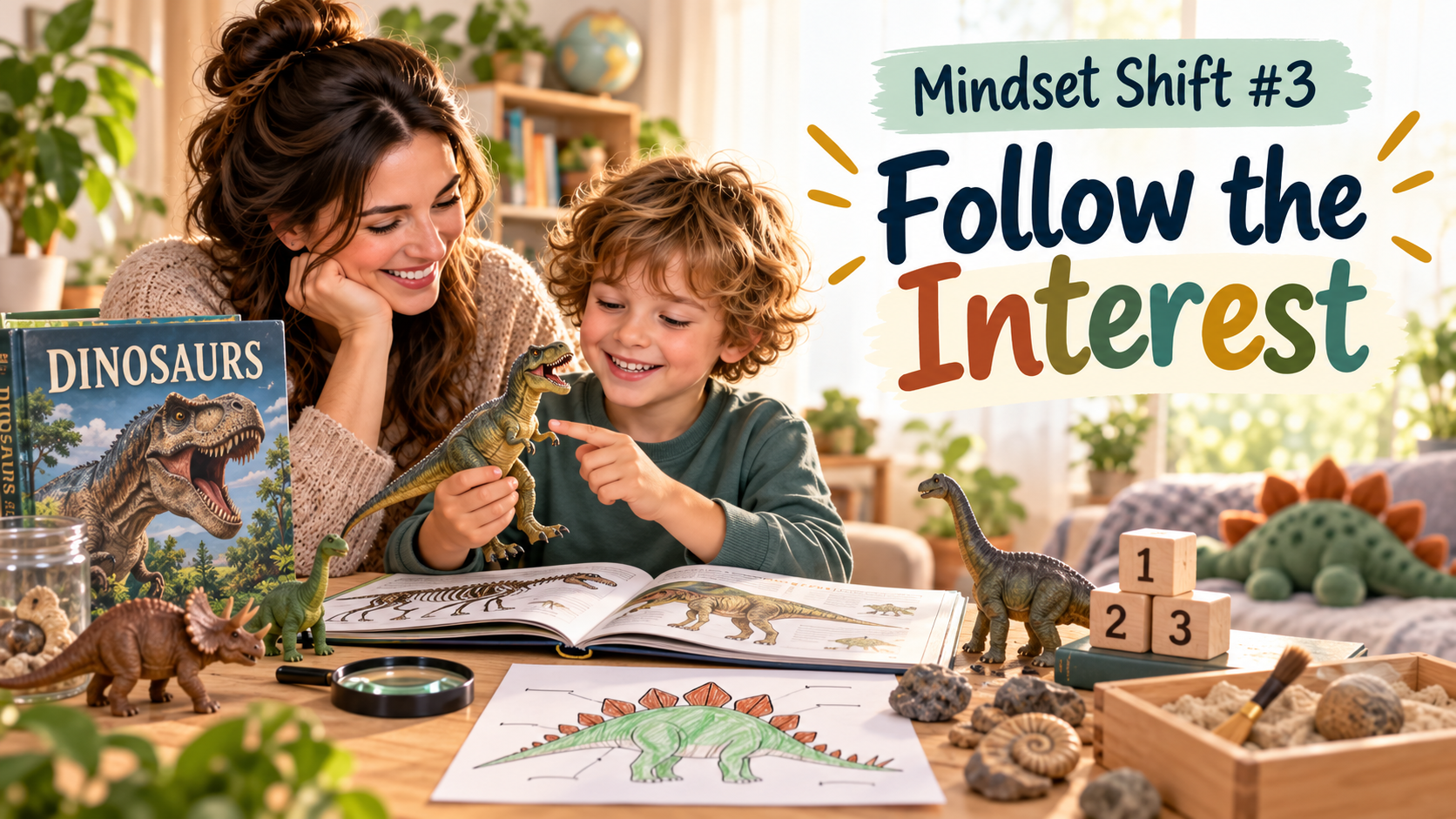
One of the biggest changes I made was learning to stop seeing my child's interests as distractions.
Sometimes an interest is the doorway into learning.
If your child loves dinosaurs, use dinosaurs.
Read books about them.
Write dinosaur names.
Compare their sizes.
Look at where fossils have been discovered.
Use dinosaurs for science, geography, reading, writing, and math.
If your child loves Minecraft, use Minecraft.
If they love horses, cooking, drawing, building, trains, maps, insects, space, or something you know almost nothing about, start there.
You do not have to teach only what your child is interested in.
But you can use what they already love as a bridge to something new.
Sometimes the thing we think is getting in the way of learning is actually the way into it.
Mindset Shift 4: Make Learning Flexible, Hands On, and Playful
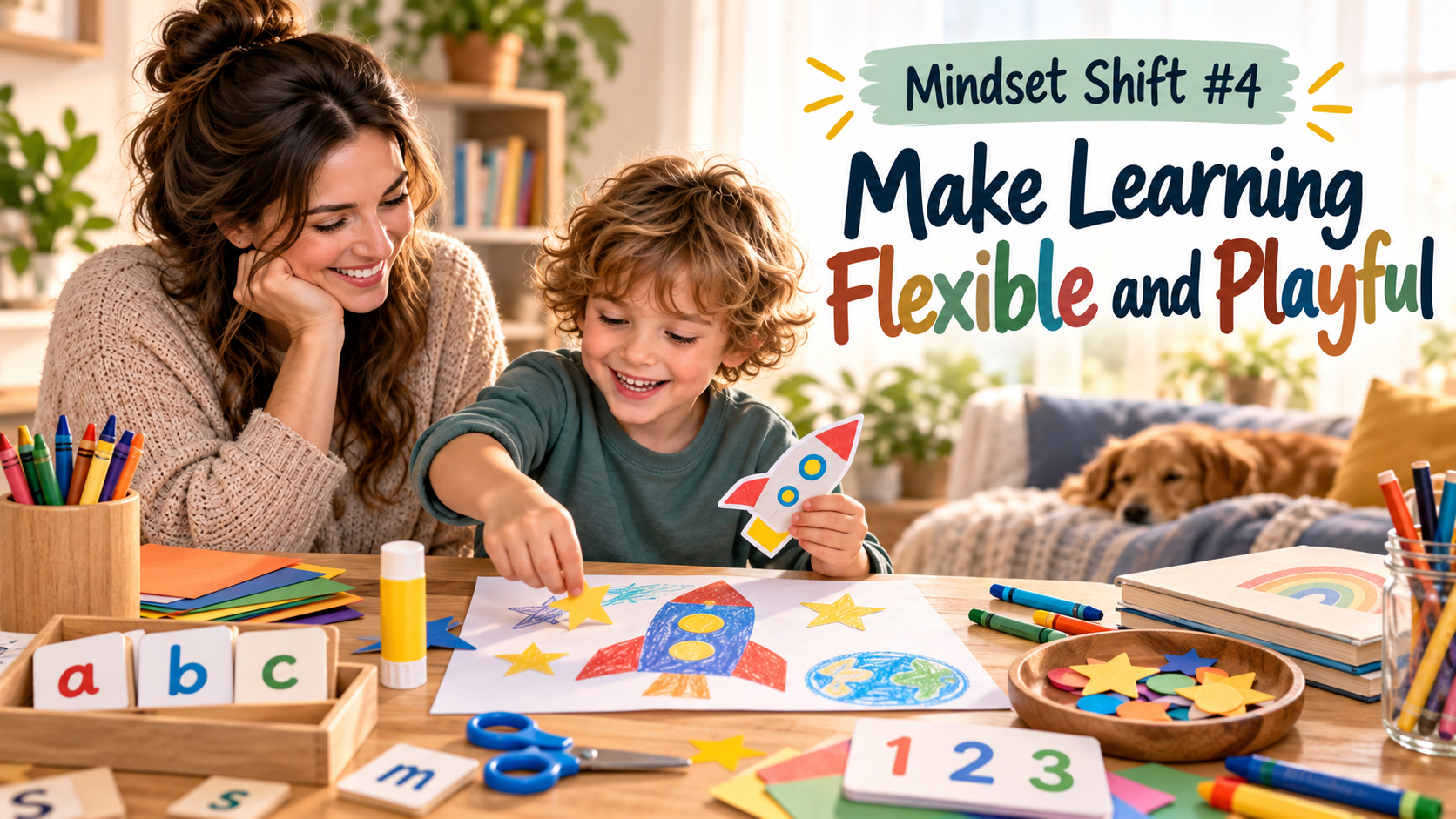
Learning and play do not need to live in two separate worlds. For many children, especially younger children, learning can happen naturally through movement, play, exploration, and everyday experiences.
Learning does not always have to mean sitting at a desk with a worksheet. Math can happen while cooking, counting steps on a walk, comparing the lengths of sticks, or solving a simple problem before racing down the slide. Reading can happen while looking at street signs, park signs, menus, labels, or favorite books. Writing can happen with chalk on the sidewalk, by tracing letters in sand, or by writing down things your child notices outside.
Math problems can be built with blocks, stones, buttons, sticks, or other hands on materials. A child who does not want to complete ten math problems on paper may happily solve those same problems as part of a game. A child who does not want to practice spelling may be willing to build words with letter tiles, write them in sand, paint them, or hunt for them in a book.
Outside, you can also turn curiosity into learning without making it feel like a formal lesson. Count rocks, look for shapes, talk about insects, clouds, plants, or weather, or let your child close their eyes and guess an object by touch before describing it. A child who cannot focus while sitting at a table may learn much more while moving, exploring, and interacting with you.
The learning is still happening. It just looks different.
When education and play overlap naturally, learning can become more engaging, more meaningful, and often much easier for a child to approach.
If you are looking for more ideas for adapting learning around your child’s interests, strengths, and learning style, I also created a book series with hundreds of hands on and individualized learning ideas. The activities are designed to help parents move beyond worksheets and find practical ways to make learning more engaging through play, movement, everyday materials, and topics their child already enjoys.
Explore the hands on learning book series →
The goal is learning. The route can be flexible.
Mindset Shift 5: Let Go, Adapt, and Trust the Process
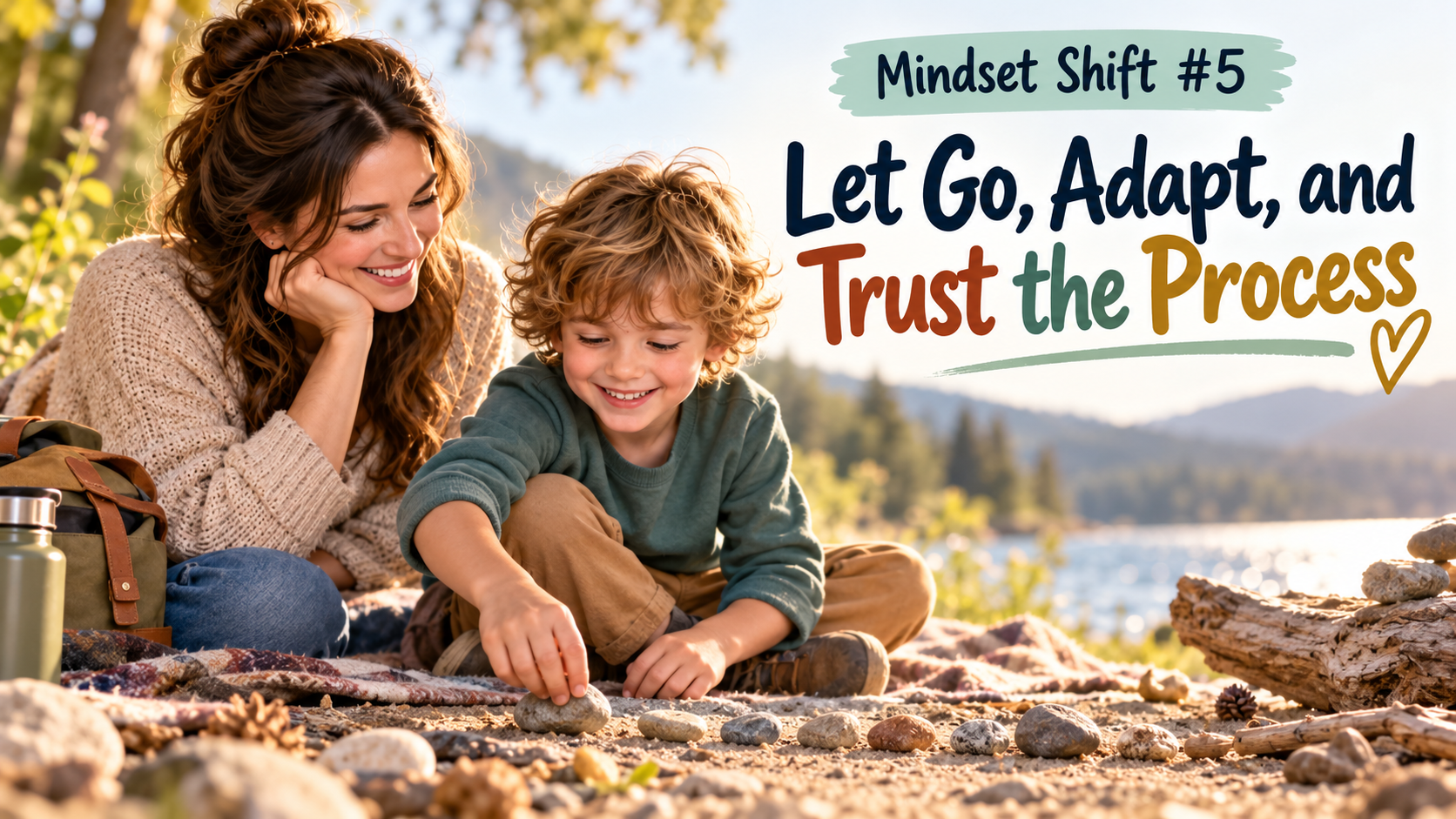
This may be one of the hardest changes for us as parents.
We make plans.
We prepare lessons.
We picture how the day should go.
And then it does not.
Your child refuses.
They become frustrated.
They lose focus.
They shut down.
And you find yourself thinking:
Why can't we just get through this?
That is usually the moment when pushing harder is most tempting.
It is also the moment when I have learned that I may need to let go.
Let go of the worksheet.
Let go of the schedule.
Let go of the idea that the day needs to look the way I imagined it.
If something is not working, change it.
Take a break.
Move.
Go outside.
Follow an interest.
Try a different material.
Come back later.
Sometimes one of the most useful things we can say is:
“This isn't working right now. Let's try another way.”
That is not giving up.
That is adapting.
It is learning your child.
Our children do not all follow the same timeline.
They do not all learn in the same way.
And progress is not always obvious from one day to the next.
Sometimes you do not realize how much has changed until you look back several months later.
The Part I Keep Coming Back To
While we are teaching our children, we also have to train ourselves.
If we have spent years worrying about what our child struggles with, our brains can become very good at finding the problems.
We notice the meltdown.
The unfinished work.
The lesson that failed.
The skills they have not mastered yet.
How far they still have to go.
And sometimes we forget to stop and look at how far they have already come.
So practice looking.
Look for their strengths.
Their interests.
Their creativity.
Their personality.
Their effort.
Their growth.
Slowly, something begins to change.
You stop seeing only the struggles.
You start seeing the whole child.
And something changes in you too.
You become less afraid of doing things differently.
Less afraid that your child is not where they “should” be.
Less afraid that you are failing because your homeschool does not look like someone else's.
You become more willing to say:
“This isn't working. Let's try another way.”
And your child feels that change.
They feel when we notice their effort.
They feel when we celebrate their progress.
They feel when we stop comparing them to everyone else.
They feel when we believe in them.
That does not mean we stop having goals.
It does not mean we ignore the areas where our children need support.
It means we stop allowing the struggles to become the entire story.
Because your child is so much more than what they cannot do yet.
There is growth happening in tiny moments.
There is learning happening in unexpected places.
There is progress happening in ways you may not always recognize.
Sometimes we just have to slow down enough to see it.
When you change the way you see your child, you change the way you respond to your child.
And when the learning environment changes, your child can begin to experience themselves differently too.
They can begin to think:
I can learn.
I can try.
I can make mistakes.
I can try again.
I am capable.
So if you are in the middle of a difficult homeschool season, you do not have to fix everything today.
You do not need the perfect curriculum.
You do not need the perfect homeschool.
You do not need to have all the answers.
Look for the next step.
Look for the little win.
Celebrate it.
And build from there.
When your mind starts telling you:
“We're behind.”
“They're not doing enough.”
“This isn't working.”
Ask yourself one more question:
What am I not seeing?
The goal is not to stop seeing the hard things.
The goal is to stop letting the hard things become the only things you see.
See your child.
Believe in them.
Celebrate them.
And keep moving forward, one small step at a time.
Because sometimes the first person who needs to believe that those tiny steps are taking your child somewhere is you.
Continue Reading
SEN Homeschooling: Flexible Learning for Children With Special Needs and Learning Differences
If you are looking for more practical ways to adapt homeschooling around your child’s strengths, interests, attention, movement needs, and learning style, continue with my SEN homeschooling guide.
It includes ideas for creating a more flexible homeschool day, choosing learning activities that fit your child, and making lessons more manageable when traditional approaches are not working.
